thought leadership collides with learned experience to yield practical advice

  • A digital filing cabinet, even with a good search bar, is still just a dumping ground.

    That’s the trap I see most often when organizations say they have a knowledge management strategy: they’ve built a place to store information—invested in what appears as a digital workplace on the surface, but without a mechanism to actually leverage it… surface it… extract the value from it… nor the loop to improve it over time.

    Capture isn’t completion. Storage isn’t a strategy.

    I joined Happeo Unmuted to dig into this… why content management and KM get conflated and what it costs organizations when they do. We even hit on what I’ve come to refer to as ‘Watermelon Projects’: things in-flight that look green and healthy from a status-report distance, but are red the moment you cut into them. Your org should be learning from these, not repeating the same mistakes over and over again.

    One thing I’ve been chewing on since this debuted: the gap almost never shows up in the tooling. The pattern repeats… the knowledge is rarely missing; it’s just orphaned. It lives in someone’s head, or a single stakeholder’s inbox, disconnected from the rest of the org. The fix isn’t a better repository. It’s building the connective tissue… good ol’ people-process-tools harmonization… the ‘constellation’ work of seeing where teams, systems, and priorities actually align, and where they quietly don’t.

    That’s the work I find most energizing: taking messy, distributed knowledge across a portfolio and turning it into something an organization can actually act on. If you’re wrestling with a similar problem, or just want to compare notes on where your KM strategy breaks down, I’d enjoy the dialogue.

    Thanks especially to host Jesse Bourgeault-Trickey, for having me—and more broadly, to founder Perttu Ojansuu and the Happeo team for creating and sustaining a platform like Happeo Unmuted at all. I think too much of the KM conversation happens in vendor whitepapers or behind closed doors at over-hyped conferences.* Giving real-world practitioners a recurring, public forum to actually debate what knowledge management means (and where most organizations get it wrong) is a real contribution to the field, independent of whose product anyone happens to favor.

    *Incidentally, this is one of the trends the Empower KM Conference is trying to turn around as a refreshingly accessible, rich, and inclusive conference option. Check it out!
  • Empower KM Conference Logo

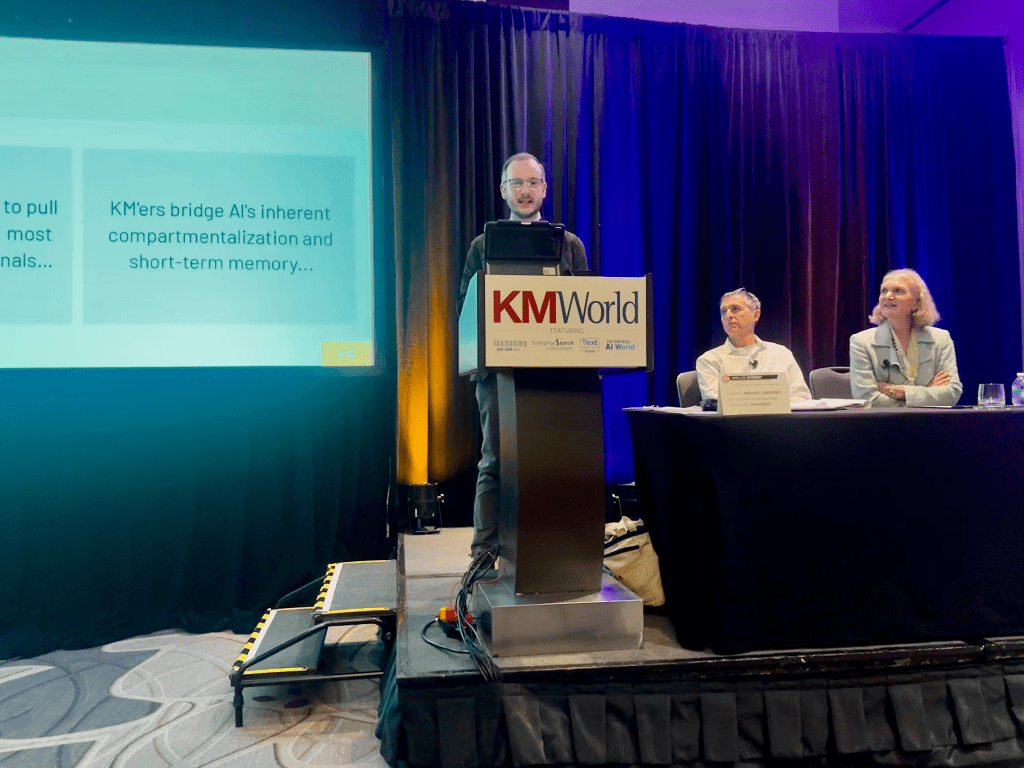
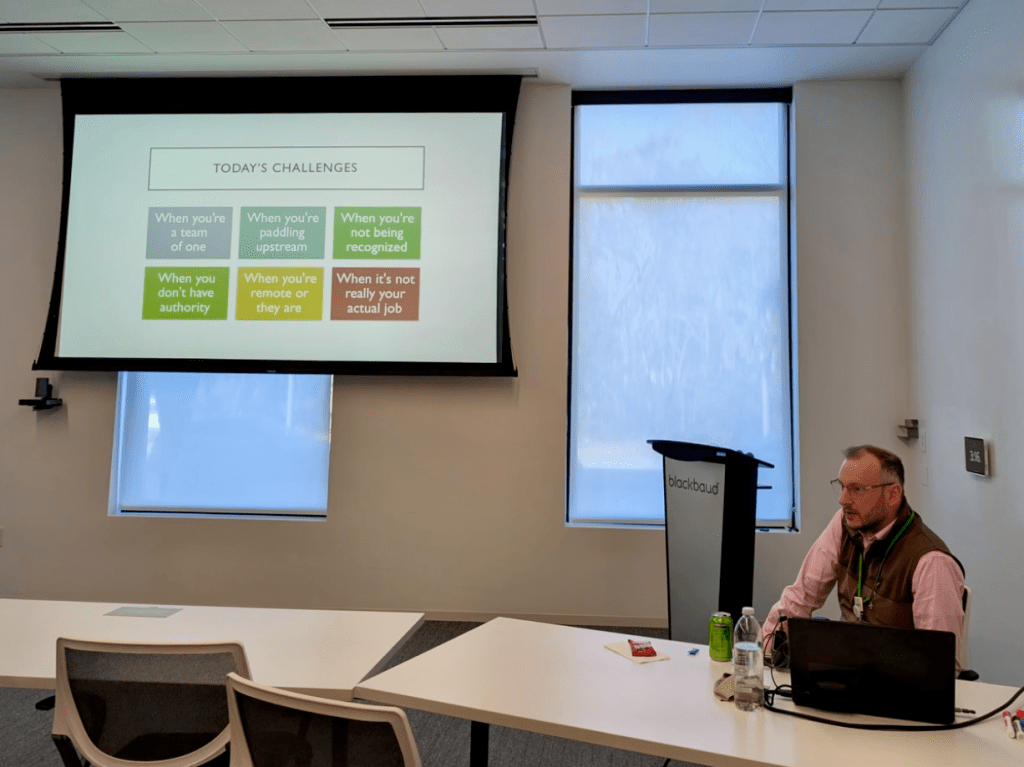
    Thanks for attending my session at Empower KM!

    Pre-Session Playlist

    1. Nora En Pure – Riverwards Stream
    2. Rezident & Von Boch – Hold On (featuring Elissa Mielke)
    3. Alex Brandt & Flexxus – Undercover
    4. Dinka – Twin Towers
    5. Nora Van Elken – Fallin’
    6. King Artur & Michael Meaco – Praise You (Chill Mix by DragoN_Sky)


  • You never know what collaborations could evolve when you fully participate in something… These days, especially with Zoom, etc., it’s always tempting to just consume off-camera or multi-task during online workshops instead of really engaging with the content and contributing back. After a stimulating Guided Insights Roundtable in November, Nancy Settle-Murphy and I ended up continuing the conversation on a particular aspect from the session that we were both quite interested in exploring further together.

    Our work eventually evolved into an article and tip sheet. Across in-person and virtual, I’ve certainly been in my fair share of contentious meetings. Personally, I trend towards avoiding confrontation at all costs. Having a concise triage method at-the-ready can definitely help in being prepared for that inevitable tense situation.

    Please take advantage of our guidance:

    and the download:

    I’m very glad we took the opportunity to work together on this. Not something I would usually have written about or devoted time to… grateful for that unexpected result of full participation. If you’re not familiar, I highly recommend signing up for her email Communiqué and taking advantage of any upcoming offerings.


  • As we step into 2025 amidst rapidly evolving GenAI capabilities, one question looms large…

    How will humans and AI work together?

    If you’re energized by GenAI, are you also concerned by the problems employing it presents? Fear not!

    Knowledge Managers can provide sanity amid the GenAI mania.

    Drawing upon our collective decades of practical, applied experience across industries and the globe, my SIKM Boston co-authors and I offer this timely article exploring how we can shape the GenAI value landscape by blending human creativity with AI’s power. We argue, as KM practitioners, that we have novel approaches to harnessing this new toolset… leveraging Collectivity (facility with human intuition and interaction), Nostalgia (wielding a rich, non-linear information recall), and Selectivity (attention to weak signals).

    Collaborative Innovation

    Employing collective sense-making to enhance AI outcomes and foster trust.

    Harnessing the Past for the Future

    Dynamic curation of historical knowledge to improve AI’s accuracy and relevance.

    Breaking the Mold

    Out-of-box thinking to unlock hidden opportunities and mitigate the risks of AI conformity.

    2025 is the year to lean into collaboration between human knowledge-based expertise and GenAI. The future isn’t about AI replacing human knowledge workers—it’s about creating an evolving, valuable human-AI ecosystem where KM professionals play a crucial role in ensuring accuracy, context, and innovation. These behaviors will be critical. Will we seize this opportunity?

    Andrew Trickett, Eve Porter-Zuckerman, Katrina Pugh, Marc Solomon, and myself invite you to read our article and share your thoughts. Let’s shape this new landscape together!


  • If your team/organization has taken on and sustained the practice of project retrospectives (see my earlier post), I applaud you. Great initial step, but you’re not going to see the true value from this practice without going further. You’re now faced with the opportunity not only to reflect and maybe get some clarity on the bigger picture successes and challenges, but also to memorialize those so others can actually do something with that information.

    All of those lessons learned around capturing what propelled and confronting what dragged will forever be buried in those notes/outputs unless they are actually shared, understood, and considered next time around by other teams.

    I’ll repeat:

    Lessons learned die in PowerPoint decks… unless shared, understood, and considered next time around.

    Arguably, there is a responsibility to generally socialize these lessons learned across other teams and beyond within your organization so some things actually start to take hold. These things can span what might need to be integrated into the way everyone approaches a plan, how they kick off a project, or how similar challenges are handled at any point by anyone who encounters them.

    This is true knowledge management at work, and as with any KM paradigm set up for success, will only be effective by combining the right tools, processes, and people responsible for sustaining this continuous improvement paradigm.


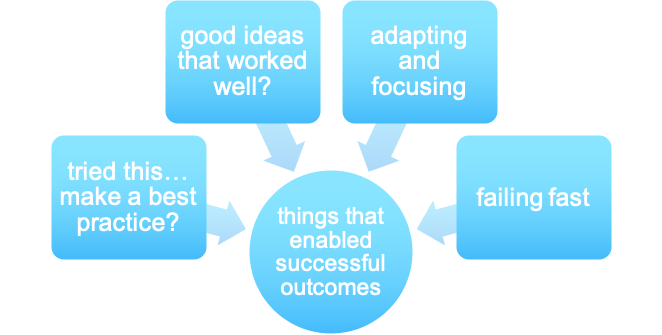
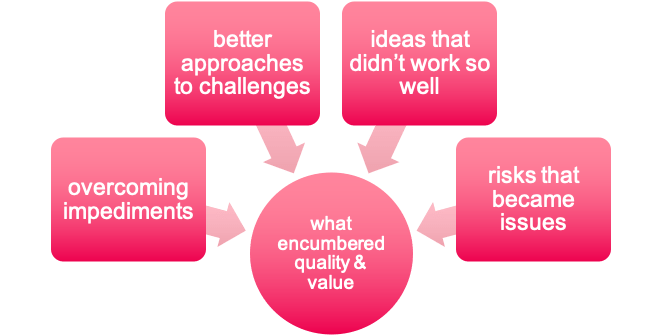
  • Quite different from the iterative practice of sprint retros (see my earlier post), an overall project review has goals that are a bit different. This is also intended for a broader audience… time to explore how everyone feels about how the project went and what was produced. An important point: sometimes this can be done with a client and sometimes without. Of course, the focus may be substantively different in each of those cases. Just like a sprint retro, the idea is not to make a case for who to blame or ‘for the record’ airings of grievances—we want to capture the things that enabled successful outcomes and confront what encumbered quality and value.

    Here are some examples of what could be good to discuss…

    Capture what propelled

    Try to determine what is repeatable and sustainable.

    Confront what dragged

    Consider what was detracting from delivering well.

    Basically, we want to figure out what to adopt and what to avoid; can’t say it more simply than that.

    The who and how is bit different from sprint retros…

    Who

    Involve everyone who contributed anything at any point—even if the team had a developer or designer a few months ago that is now on a different project, they need to be invited and make time to contribute to a complete picture.

    • Project Manager
    • Sales
    • Product Manager/Product Owner
    • Technical Lead(s)
    • All team members involved in delivery throughout
      • Not just who was on the project at the end

    Keep in mind that it may or may not be appropriate to do an internal and external project retro separately or combined.

    How

    It is essential to have an agnostic teammate facilitating (someone uninvolved with the project). Having the facilitator be impartial means they will be able to record things in a way that doesn’t assume a lot of the nuances and context that the project team has—because others who weren’t involved need to be able to understand the takeaways.

    • Someone from outside the project should facilitate
      • prompt people
      • record +s and –s
      • encourage participation
        • Not pass judgment or validate/invalidate the contributions
    • Artifact (deck, notes, etc.) produced with key summary points that can be approached and consumed by anyone without project context

    The key here is assembling that artifact in a consumable manner and making it available; that means it’s findable and accessible/not locked down to those who could benefit from the contents!


Categories

Adoption Agile AI Analytics Bugs Change Management Cloud Delivery Excellence Digital Strategy Digital Workplace Enterprise Content Management Humans Hybrid InfoPath Information Architecture Information Governance Information Management Interviews Knowledge Management Meetings Navigation Office 365 Podcasts PowerShell Presentations Project Management Resources Sample Data Sets Search SharePoint SPS Events Tools User Experience Workflow

Archives